Our Mission
Promoting remembrance, dignity, reconciliation, and historical accountability for victims of the transatlantic slave trade.
We believe that everyone deserves dignity, even in death, and that restoring the dignity of enslaved Africans whose deaths were overlooked is essential to healing the emotional wounds of the victims’ descendants.
The history, memory, and legacy of the millions of Africans who were forcibly taken from their homes and subjected to the transatlantic slave trade belong to humanity and must be preserved for future generations.
Our mission is to promote understanding of the transatlantic slave trade and its enduring consequences; strengthen historical preservation, remembrance, reconciliation, and cultural restoration; and provide the knowledge, documentation, and international cooperation needed to honor the victims and inform public dialogue, education, and policymaking.
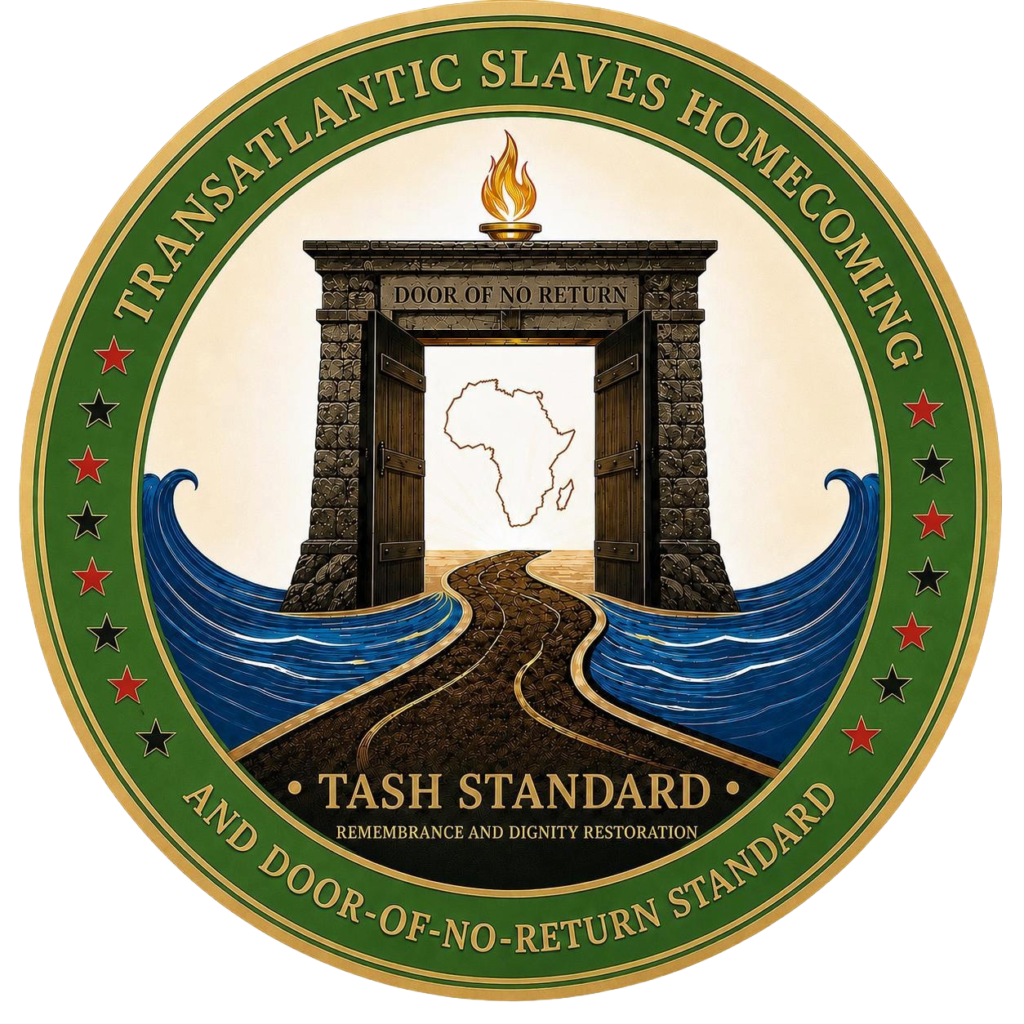
By joining the Transatlantic Slaves Homecoming and Door-of-No-Return Standard (TASH Standard), countries commit to preserving and protecting Doors of No Return, slave ports, embarkation sites, memorial landscapes, and other sites associated with the transatlantic slave trade. Member countries also commit to supporting the respectful recovery, documentation, and symbolic repatriation of soil and memory from sites of enslavement across the Americas and other regions, and to promoting historical truth, remembrance, reconciliation, and education.
By participating in the TASH Standard, member countries agree to a common set of principles, requirements, and commitments that govern remembrance, memorialization, site preservation, diaspora engagement, historical documentation, and the implementation of the Transatlantic Slaves Homecoming initiative.
As global interest in historical justice, cultural restoration, and ancestral reconnection continues to grow, the TASH Standard can play a key role in raising awareness of the transatlantic slave trade’s enduring impact on societies across Africa, the Americas, the Caribbean, Europe, and beyond. The TASH Standard supports efforts to preserve endangered historical sites, document overlooked histories, foster reconciliation, promote educational initiatives, and create pathways for meaningful engagement between Africa and Afro-descendant communities worldwide.
The TASH Standard provides a framework for governments and international partners to collaborate to ensure that the stories, sacrifices, and legacies of enslaved Africans are acknowledged, preserved, and honored.
In every country adopting the TASH Standard, a multi-stakeholder group — including government officials, traditional authorities, civil society organizations, and historians — assists with its implementation.
At a glance
Four constituencies
Countries, heritage & traditional authorities, civil society & descendant communities, and academic & institutional partners each hold a seat in TASH governance.
TASH Standard
The global benchmark for remembrance
Recognition, preservation, and symbolic repatriation.
Implementing Countries
Global adoption of the TASH Standard
Countries preserving Doors of No Return worldwide.
Governance
How we are governed and organised
Members’ Meeting, TASH Board, and Secretariat.
Our TASH priorities
Our priorities reflect TASH’s strategic objectives and the key areas in which we support countries with implementation of the TASH Standard.
Culture
Our values
Our culture and decision-making are driven by our core values of dignity, integrity, and respect for historical truth.
Our Code of Conduct seeks to ensure TASH stakeholders observe the highest standards of integrity. It applies to all TASH Office Holders, including Members of the TASH Association, Board members, their alternates, Secretariat staff, and members of multi-stakeholder groups.