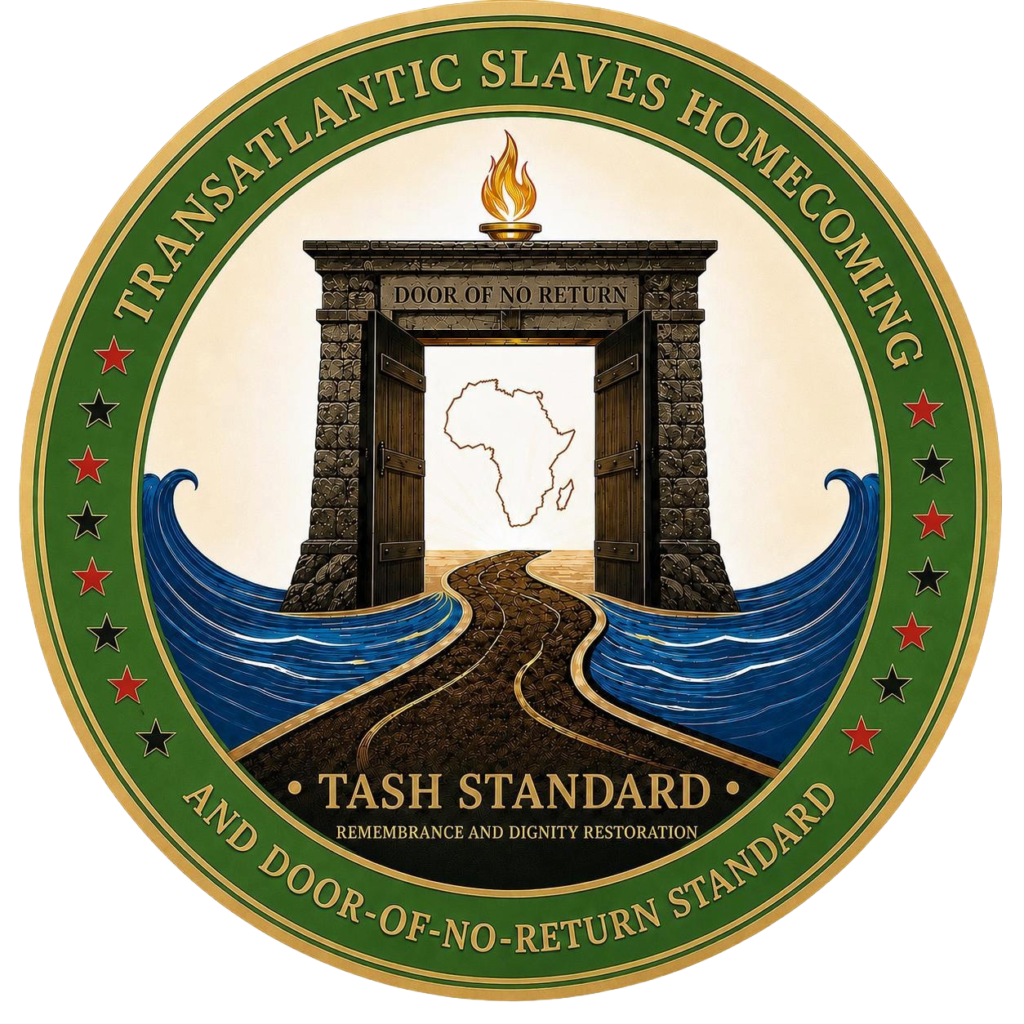
Historical Background
How growing international recognition of the transatlantic slave trade’s enduring injustices gave rise to the TASH Standard.
The Transatlantic Slaves Homecoming and Door-of-No-Return Standard (TASH Standard) was conceived amid the international community’s growing recognition that the transatlantic slave trade, slavery, and colonialism constitute enduring historical injustices whose consequences continue to affect peoples of African descent and humanity as a whole. The Standard reflects the evolving commitment of States, regional organizations, civil society, traditional authorities, descendant communities, and international partners to strengthen remembrance, historical accountability, reconciliation, and the restoration of human dignity.
The Standard also acknowledges the historical reality that millions of Africans were forcibly removed from their homelands through the transatlantic slave trade and subjected to enslavement, forced displacement, exploitation, and inhumane treatment. Countless individuals perished during capture, forced marches, confinement, the Middle Passage, and enslavement across the Americas and the Caribbean. Many were denied proper burial, their identities were erased, and their lives were neither formally acknowledged nor commemorated. These historical circumstances continue to resonate with descendant communities seeking healing, historical recognition, spiritual reconciliation, and opportunities for symbolic and cultural reconnection with the African continent.
The TASH Standard further recognizes that, despite the presence of important memorials and heritage sites associated with the transatlantic slave trade, no comprehensive international framework has linked places of departure in Africa with sites of enslavement and remembrance across the Americas, the Caribbean, and other regions affected by the transatlantic slave trade. Establishing such a framework contributes to preserving historical memory, promoting educational understanding, encouraging international cooperation, and restoring dignity to those whose humanity was systematically denied.
Recognized as
The Sixth Region
The 2021 and 2025 Africa–CARICOM Summits recognized the African diaspora as the Sixth Region of the African Union, affirming its enduring relationship with the continent.
How the Standard took shape
Timeline
Key milestones informing the development of the TASH Standard.
Africa–CARICOM Summit
Reinforced cooperation between the African continent and the Caribbean Community and advanced dialogue on reparatory justice, historical remembrance, and the strengthening of relations between Africa and its global diaspora.
Africa–CARICOM Summit
Built on the outcomes of 2021, further recognizing the African diaspora as the Sixth Region of the African Union and affirming its enduring historical, cultural, and developmental relationship with the African continent.
African Union Resolution
Declared that slavery and colonialism constitute genocide and crimes against Africans, and designated 30 November as the African Day of Tribute for Martyrs and Victims of the Transatlantic Slave Trade, Colonization, and Apartheid — reaffirming remembrance, historical truth, and collective responsibility.
Houston, Texas, United States
The TASH Standard was formally launched in Houston, a city with historical significance as part of the Deep South, where generations of enslaved Africans and their descendants endured forced labor under the institution of slavery. The selection reflects the Standard’s commitment to transforming places historically associated with enslavement into spaces dedicated to remembrance, reconciliation, education, and international cooperation.
Purpose
A voluntary international framework
The Transatlantic Slaves Homecoming and Door-of-No-Return Standard (TASH Standard) establishes a voluntary international framework to guide the preservation, documentation, recognition, and commemoration of the human consequences of the transatlantic slave trade. It provides common principles and guidance for governments, regional organizations, local authorities, cultural and educational institutions, civil society organizations, traditional custodians, descendant communities, and international partners seeking to strengthen historical preservation and promote respectful remembrance.
The Standard supports initiatives that preserve sites of historical significance, encourage documentation and, where appropriate, the symbolic repatriation of soil and memory associated with places of enslavement, foster educational and cultural exchange, and strengthen cooperation among communities connected by the history and legacy of the transatlantic slave trade. Through the Transatlantic Slaves Homecoming initiative and the preservation and recognition of Doors of No Return and related memorial sites, the Standard seeks to promote historical continuity between Africa and the global African diaspora and to encourage reconciliation grounded in truth, remembrance, and respect for human dignity.
Guiding principle
Remembrance as prevention
The TASH Standard is grounded in the principle that remembrance serves not only to honor those who suffered and perished but also to promote education, mutual understanding, intercultural dialogue, and the prevention of future atrocities.