How TASH is governed and organized
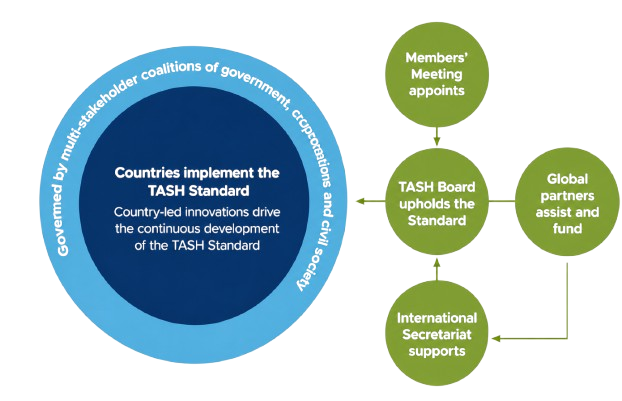
TASH is a multi-stakeholder organization comprising governments of implementing, supporting, and descendant countries, as well as corporations and civil society organizations. The TASH Board serves as its main decision-making body and is supported by the TASH International Secretariat.
TASH is governed by the TASH Articles of Association, which form part of the TASH Standard. It is registered as a non-profit association under Cameroon law.
Legal status
Non-profit association
Registered under Cameroon law, governed by the TASH Articles of Association.
TASH Association
Three permanent institutional bodies
TASH, legally the “TASH Association”, consists of three permanent institutional bodies: the Members’ Meeting, the TASH Board, and the International Secretariat. Together, these bodies uphold and safeguard the TASH Standard.
As the highest governing body of TASH, the Members’ Meeting gathers representatives from three constituency groups to elect the TASH Board every three years in connection with the TASH Global Conference.
Decision-making
TASH Board
The TASH Board is TASH’s main decision-making body. It decides priorities for the organization and evaluates countries’ progress in meeting the TASH Standard.
The TASH Board is a multi-stakeholder group consisting of representatives from implementing countries, supporting countries, descendant countries, as well as corporations and civil society organizations. Each Board member, except the Board Chair, is invited to have an alternate, to observe Board meetings and deputize for the member.
The TASH Board’s decision-making is consensus-based. It makes decisions during Board meetings, which are held two to four times a year, and via Board circulars.

Structure
Constituencies
The TASH Association comprises three constituencies — countries, corporations and civil society organizations — which are represented on the TASH Board and at the Members’ Meeting. Some constituencies also have sub-constituencies that represent specific industries and geographical regions.
Constituencies are self-governing entities that appoint representatives to the Members’ Meeting and nominate members to the TASH Board. Constituencies and sub-constituencies agree on guidelines to steer their nomination processes and improve accountability and information sharing within their groups.
National implementation
Multi-Stakeholder Groups
In each implementing country, TASH implementation is led by a multi-stakeholder group (MSG) of representatives from government, corporations and civil society. This group sets objectives for TASH implementation linked to each country’s national priorities, oversees TASH reporting and ensures that disclosures contribute to public debate and reforms.
While the MSG has a mandate to determine the scope of TASH implementation in its country, the TASH Standard sets minimum requirements for the MSG’s role, rights and responsibilities. This includes the full, free, active and effective engagement of government, corporations and civil society.
Integrity
Code of Conduct
TASH’s Code of Conduct is designed to ensure that TASH stakeholders uphold the highest standards of integrity. It applies to all TASH Office Holders, including Members of the TASH Association, TASH Board members, their alternates, secretariat staff (national and international), and members of multi-stakeholder groups. It is part of the TASH Standard.
Stakeholders who believe there has been a violation of the TASH Association Code of Conduct may address it in accordance with Article 12 of the Code, which sets forth the procedure for reporting concerns.